
OEM Leather Shoe Comfort: How to Create Truly Comfortable and Durable Custom Leather Shoe Solutions
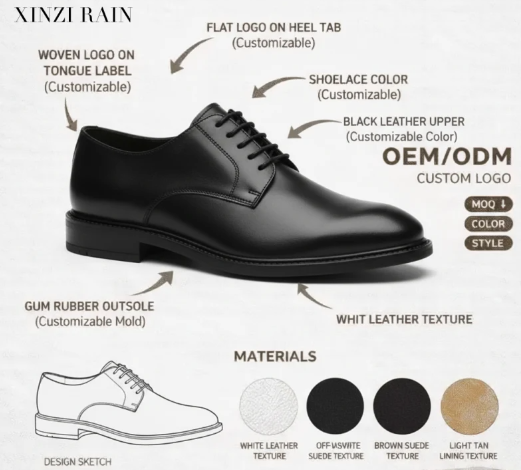
Poor comfort: the most common pain point of OEM genuine leather shoes
In the high-end footwear market, the comfort of OEM leather shoes is one of the most important factors for brands and buyers. Many customers frequently experience problems such as poor breathability, blisters, and insufficient support, all of which directly impact user experience and brand reputation.
In mass production, if comfort leather shoe OEMs lack consistent standards, batch-to-batch quality differences can easily occur.
The core issue with the comfort of OEM leather shoes lies not only in the choice of materials, but also in the lack of ergonomic structural design and system-level optimization.
The core principle of comfort: systems engineering approach
The comfort of high-quality OEM leather shoes is not determined by a single factor, but by a complete system including last design, material selection, and internal structure optimization.
The shoe last determines how well the shoe fits the foot, while the materials used by breathable leather shoe manufacturers affect airflow and moisture control. Meanwhile, the insole structure directly impacts comfort during extended walking.
Therefore, OEM shoe factories must ensure quality control throughout the entire process from design to final production to guarantee consistent comfort output.
OEM Production vs. Traditional Manufacturing: Key Differences in Comfort
In the traditional manufacturing model, footwear production focuses more on cost and output, often neglecting the ergonomic design principles of formal dress shoes OEM design.
In contrast, professional OEM factories will make the following optimizations:
- shock-absorbing outer bottom structure
- Leather flexibility control
- Internal pressure distribution
- Long-term wear test
This is why OEM leather shoes are more competitive in terms of comfort in the high-end market.
Solution: How to improve the comfort of OEM footwear
To achieve consistent comfort in OEM genuine leather shoes, optimization is needed in the following three aspects:
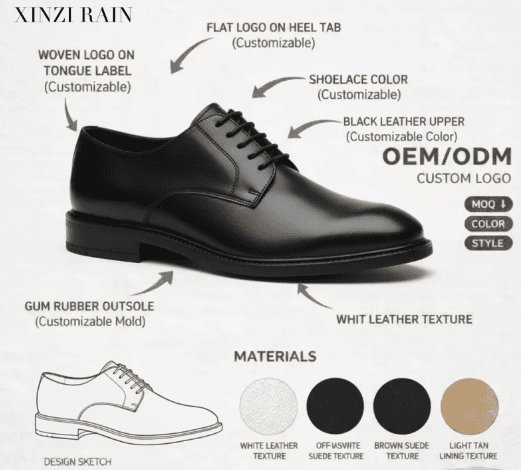
First, material selection – breathable leather and soft lining materials should be given priority.
Secondly, structural design – optimizing pressure distribution through ergonomic dress shoe OEM models.
Third, production control – ensuring the consistency of every batch of comfortable leather shoes OEM.
Click here to view product features:
https://www.herrains.com/zh-Hans/products/footwear
Core Advantage: Why Comfortable OEM Shoes Win the Market
High-quality OEM genuine leather shoes are not only comfortable to wear, but also enhance the brand's high-end positioning.
Key advantages include:
- Higher customer retention rate
- lower rate of return
- A stronger high-end brand image
- Stable long-term production capacity
For custom leather shoe manufacturers, comfort has become a core competitive advantage.
Application scenario: Actual market demand for OEM footwear
The comfort of OEM genuine leather shoes is widely used in various consumer and business settings:
- Formal business occasions
- daily commute
- Hotel and service industry
- High-end gift market
- Cross-border e-commerce sales
Different markets have different priorities when it comes to comfortable leather shoe OEM products. For example, the Western market focuses on comfort, while the Middle Eastern market places more emphasis on high-end appearance and material quality.
Selection Guide: How to Choose the Right OEM Shoe Supplier
When selecting a quality control supplier for an OEM shoe factory, the following aspects should be given special attention:
- Possesses complete product development capabilities
- Sample development support
- Stable large-scale production capacity
- Ergonomic design experience
Established custom shoe manufacturers typically offer a full range of services from design to production.
Frequently Asked Questions
Q1: Can the comfort level of OEM genuine leather shoes be customized?
Yes, different levels of comfort can be achieved by adjusting the shoe last and materials.
Q2: Is there a conflict between comfort and cost?
Not necessarily. A well-designed system can improve comfort within a controllable cost.
Q3: Do you support small-batch production?
Yes, we can provide flexible order quantities based on brand requirements.
in conclusion
Comfort is a key competitive factor in the high-end footwear industry for OEM genuine leather shoes. Through scientific last design, material optimization, and strict production control, brands can significantly enhance product comfort and long-term market competitiveness.